
Most of a school leader’s planning is knowing what has to start now for something that happens later. Backwards planning makes that visible: start from each event’s date, work back through what it needs, and you end up with a list of what each week of the term is for.
01Why plan backwards?
A calendar tells you when things happen. It does not tell you when to start them. Graduation is in late November, but the venue may need booking in August. An excursion is in Week 6, but the risk assessment has to be done before the consent forms go home, and families need time to return them.
Forward planning asks “what is coming up?” Backwards planning asks “what does this week need, for everything that is coming up?” The second question is the one that stops things being missed.
02Put the fixed dates down first
Before planning any event, collect everything that cannot move:
- Term start and end dates, and the school holidays between them.
- Public holidays, including local ones such as a show holiday.
- Student-free and professional development days.
- Events with a date already set: graduation, camps, carnivals, concerts, information evenings, reporting deadlines.
Number the weeks of each term. “Week 7” is how everyone in a school talks about time, and it is much easier to plan in than calendar dates.
03Break each event into stages
For each event, list what needs to happen and how far ahead it needs to happen. Grouping tasks into stages keeps the list manageable. One useful set of stages:
- 16 weeks before: decisions and bookings. Confirm the date, the budget and who is leading it; book anything that books out.
- 12 weeks before: planning. Draft the program, invite guests, order anything with a long lead time.
- 8 weeks before: approvals and communication. Complete the paperwork your school or system requires, and let families know.
- 4 to 2 weeks before: confirmations. Numbers, rosters, run sheet, reminders.
- The final week: setup and last checks.
The right lead times depend on your school. A small school booking its own hall needs less than a large one booking an outside venue. Treat any template, including this one, as a starting point.
Check the requirements, not just the suggestions. Risk assessments, consent, supervision ratios and approvals are set by your department, sector or governing body, and they change. Before relying on a lead time for any of them, verify the current requirements at the source.
04A worked example: Year 12 graduation
Say graduation is on Thursday 26 November 2026, in Term 4 for a Queensland state school. Counting back from that date gives each stage a due date:
| Stage | Counted back | Due |
|---|---|---|
| Decisions and bookings | 16 weeks | Thu 6 Aug (Term 3) |
| Planning | 12 weeks | Thu 3 Sep (Term 3) |
| Approvals and communication | 8 weeks | Fri 18 Sep (Term 3)* |
| Confirmations | 4 weeks | Thu 29 Oct (Term 4) |
| Final reminders | 2 weeks | Thu 12 Nov (Term 4) |
| Setup and checks | 1 week | Thu 19 Nov (Term 4) |
* Eight weeks before is Thursday 1 October, which falls in the school holidays. A due date in the holidays is a due date nobody meets, so it moves back to the last school day before them: Friday 18 September.
Two things stand out. First, half of the work for a Term 4 event happens in Term 3. Second, the holiday catch is easy to miss by hand, and it is exactly the kind of thing that lets a deadline slip.
05Turn it into a weekly rhythm
Once every event has its stages, you can read the term the other way: week by week. At the start of each week, ask three questions:
- What needs action this week? Every task due now, from every event.
- What needs deciding soon? Anything that will hold up a later stage if it waits.
- What is behind? Stages that are past due and still open.
Put the answers on one page and bring it to Monday’s leadership meeting. That single page does more to keep a term on track than any long-range calendar.
06Doing it with Principal Planner
Principal Planner was built to do this arithmetic for you. Queensland state schools start with term dates and holidays built in; every other Australian school enters its four terms once, in about two minutes.
- Choose a template for an event, give it a date, and every task gets a due date worked back from the event, never landing in the holidays.
- Move the event and its checklist moves with it.
- Plan something late and it tells you which stages are already due, rather than pretending there is time.
- Print the week: the Weekly Principal Overview puts what needs action, what needs deciding and what is behind on one page.
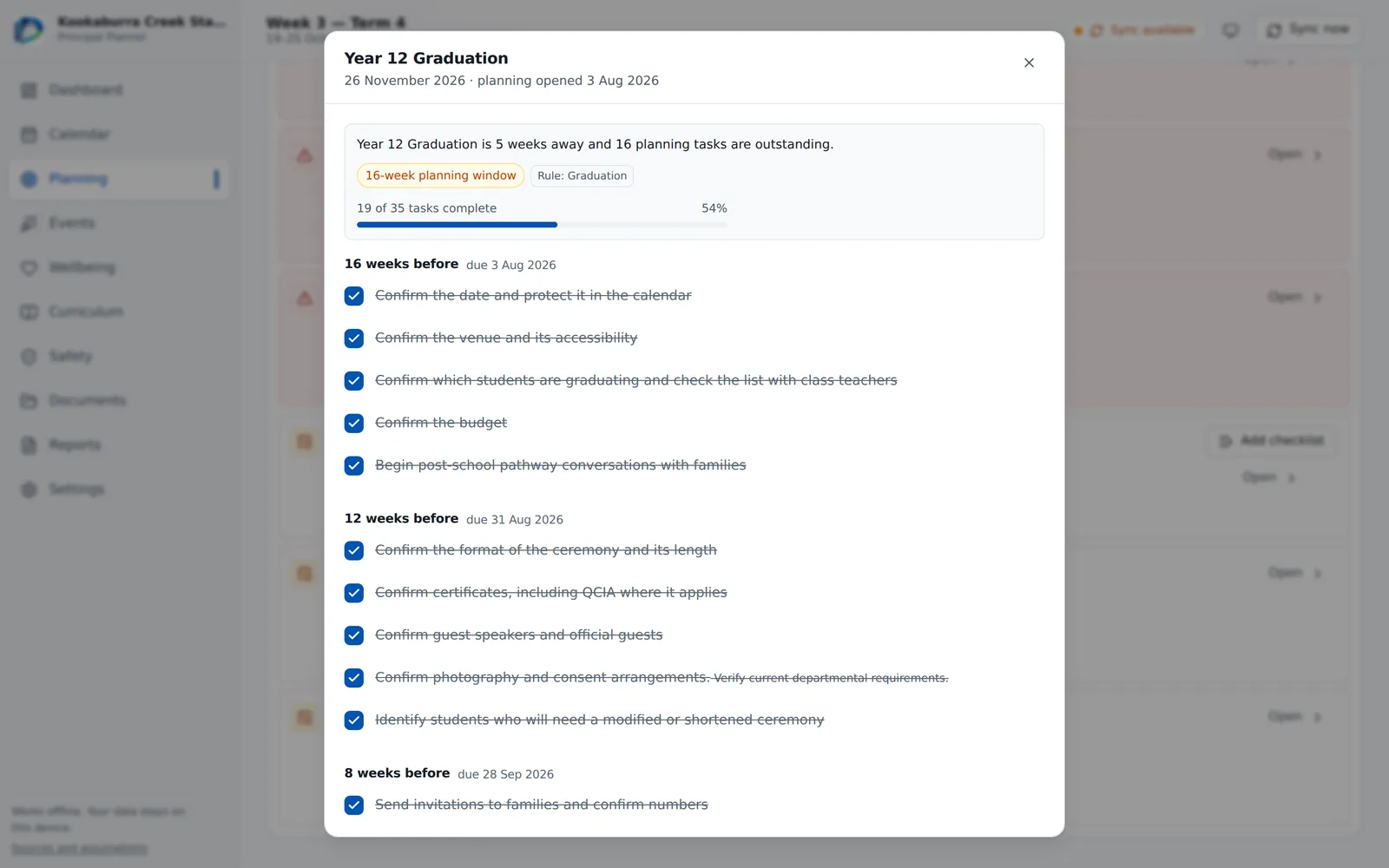
Anything that depends on departmental policy carries the words Verify current departmental requirements, so the reminder travels with the task. Principal Planner is an independent product, not made or endorsed by any education department.